Trading posts on the frontier worked on a system of credit. Natives who routinely visited the trading post to trade hides could purchase needed supplies on credit, working off their expenses by bringing in more hides, similar to paying a modern grocery bill on a running tab. One such trading post was located on an Island in the Mississippi River in the midst of what are now the Quad Cities. Credit Island has gone by a number of names over the years, such as Suburban Island or Offerman's Island, but the one that seemed to stick and become the official name was Credit.
It was at Credit Island that a young army officer and future POTUS named Zachary Taylor got one of two tastes of defeat at the hands of Natives. A war party of Sac met up with a small detachment under then-Major Taylor on September 4-5, 1814 in one of the westernmost battles of the War of 1812. The Sac won and Taylor's men had to beat a hasty retreat back to more welcoming territory. Taylor wasn't the only future celebrity on the field. A young warrior named Black Hawk likely commanded the war party. The British provided at least three small cannon, which still delivered a blistering smack-down to Taylor's pride. It wouldn't be the first time he'd be handed his desserts by a Native war party.
Gayusuta and Washington
Showing posts with label War of 1812. Show all posts
Wednesday, June 7, 2017
Monday, June 5, 2017
Opposition: Zachary Taylor, 1784-1850
Most people remember the 12 President for his short term in office, barely 15 months from March, 1849-July, 1850. Others remember his service in the Mexican War. However, long before either, Zachary Taylor was prominent in two battles against Native Americans, the Black Hawk War and 2nd Seminole War.
Like his colleague William Henry Harrison, Zachary Taylor, 1784-1850, came from a landed Virginia family. Despite their social position, they left Virginia when Zachary was still a child and settled in Louisville, Kentucky. His father became wealthy in real estate. Kentucky was still frontier and there was little opportunity for formal schooling. Whenever he could go to school, Zachary was a quick learner. He grew to manhood and enlisted in the Army in 1808. Despite the family's wealth in land, he would need a day job and the army promised steady pay and relatively light duty while he quietly invested in land, slaves, and bank stocks. In 1810, he married Margaret Mackall, also a settler in Kentucky, but from a prominent Maryland family. The couple would have six children.
In the windup to the War of 1812, he was called to Indiana to take over command of what was then called Fort Knox, now Vincennes, Indiana (not the Fort Knox we know today). He restored ordered to an unruly garrison and won the praise of Indiana Governor William Henry Harrison. At that time, James Wilkinson, the commander of the American Army, ended up under court martial and Taylor was called to Washington to testify, missing the Battle of Tippecanoe and Tecumseh's Rebellion in the process. He was soon back in Indiana, defending Fort Harrison and taking part in an expedition to what is now Illinois. His first serious encounter with Native warriors, in the Battle of Wildcat Creek on November 22, 1812, ended up in a retreat. He later won a colorfully named battle at Credit Island. He was only a captain when the War ended. He resigned his commission in 1815, and reenlisted a year later as a major.
The next few years saw Taylor in command of various outposts, rising from major to lieutenant-Colonel. He was promoted to colonel in time for the Black Hawk War of 1832. However, aside from a few skirmishes, the war soon fizzled and it was back to garrison duty. However in 1837, he was dispatched to Florida and met the Seminoles at the Battle of Lake Okeechobee on December 25, 1837. There, he faced a Native command team consisting of Billy Bowlegs, Abiaka, and Coacoochee, among others, none of them happy that, just weeks before, Osceola and Coacoochee had been taken prisoners under a flag of truce. Technically, the battle was a draw, with the Seminoles inflicting casualties on already rattled U.S. troops and Taylor's men depleting cattle and other food sources the Seminoles couldn't afford to lose. However, the U.S. government needed a diversion from the dying hero at Fort Moultrie who'd captured the public's imagination and billed Okeechobee as a victory, promoting Taylor to Brigadier-General.
At about this time in his life, Taylor began to think about politics, using his new military fame to transition to a peacetime career. The Mexican War intervened in 1846-1848, but after the war was over, it was Taylor's turn to run for President. He was inaugurated in March, 1849, and served for little over a year. On July 4, 1850, he attended a picnic in Washington, D.C. and ate cherries washed down with milk on a hot day. Within a few hours, he was complaining of stomach troubles. Days later he was dead of cholera, most likely food poisoning from whatever he'd eaten on July 4th, compounded with the crude medical tactics of the day such as purging and bleeding. A 20th century autopsy on his remains found no evidence of poisoning or other foul play.
Years later, after having agreed to remove to Oklahoma, Billy Bowlegs would come Washington D.C. on a delegation. Touring the U.S. Capitol, he saw a picture of Taylor and smiled. He pointed to himself and said, "me whip!" I beat him!
Thursday, April 6, 2017
Comedy of Errors: the Battle of Maguaga, August 9, 1812
Battles can be grand games of tactics and strategy, or they can be a case of fumble, bumble and stumble, with tragic consequences to the men involved. This battle, fought near present-day Monguagon, Michigan, was one of the opening skirmishes of the War of 1812, and it did no credit to either side.
European regiments had an almost impossible time adapting to methods on the North American frontier. Fancy uniforms and parade ground discipline made no difference in the wilderness. American militia, who wore their own clothing and were used to hunting and shooting in the terrain, were often poorly disciplined. Native auxiliaries were meant to bridge this gap, combining skirmishing, scouting and surveillance with natural camouflage and survival skills. At least, in theory. However, even the best auxiliaries were often only as good as the men who commanded them and here, where able Native leaders such as Roundhead of the Wyandot, Tecumseh of the Shawnee and Main Poc of the Potawatomi were all present, their British chain of command let them down.
Nor were the Americans fairing better in terms of leaders. General William Hull had planned to use Fort Detroit as a base for an invasion of Canada. However, hearing that the British had retaken Mackinac Island, he decided not to attack across the Detroit River on Fort Malden, now Amherstburg, but to drop back to safer American territory, leaving a small garrison at Detroit. Two supply columns set out from Detroit to resupply Hull. One was defeated at the Battle of Brownstown. A second, larger column was sent to escort that supply train back to Detroit and ran into a detachment of the British 41, with Native auxiliaries. The Americans had 280 Regulars and 330 militia. The British had 70 Regulars, 70 Native auxiliaries and 60 militia.
Things went downhill almost immediately for the British, standing out against the terrain in their scarlet uniforms. American sharpshooters quickly went to work. Potatwatomi auxiliaries under Main Poc tried to reinforce the British but the British, panicking, though these were more Americans who had come up on their flank. They opened fire on their own auxiliaries, who had to fire back to spare their own lives. The two sides traded fire for several minutes until they figured out their mistake. Meanwhile, the British commander thought he saw weakness on the American front and ordered his men to attack. His militia misunderstood the drumbeat and trumpet calls signals and instead withdrew. This was a golden opportunity for the Americans and their commander ordered an advance. The British had meanwhile regrouped to make a stand, at which point the Americans simply vacated the field without pressing a clear advantage. Americans, 18 killed, 64 wounded, 2 captured. British, 16 killed, 2 missing and 8 wounded.
The American commander, James Miller, was clearly shaken by his first experience of combat. His men had thrown their knapsacks away prior to the battle, and as they left the field, didn't stop to pick them up. Ill and disoriented, Miller refused to go back for the supplies. Hull, fed up, ordered Miller back to Detroit. Luckily for him, he would redeem himself later in the War, ending up a Brigadier General, but he narrowly escaped a court-martial and charges of insubordination and cowardice.
Saturday, April 1, 2017
Natives versus Settlers: Battle of Brownstown, August 5, 1812
Fighting a colonial war was always costly in money, men and materiel for any European power. In North America, the French and British made frequent use of their Native auxiliaries, often sending trusted warriors to fight directly with soldiers of the other country, or the Americans, when resources were spread then. During the War of 1812, the British had need of effective fighting men and commanders to lead them. Tecumseh, a warrior with a proven track record, was a valuable asset.
Brownstown was a Wyandot village located on Brownstown Creek near Fort Detroit, in what is now Gibraltar, Michigan. The Wyandot of this village supported the U.S. and likely Major Thomas van Horne, on the way to the Raisin River to pick up beef on the hoof to return to Major General William Hull at Fort Detroit, thought he was safe enough. Tecumseh and Roundhead, with 25 Shawnee, Chickamauga and Wyandot warriors quickly set him straight, ambushing Van Horne's party of 200 troops. Van Horne's men, most of them untrained militia, lost their nerve and scattered, 18 killed, 12 wounded, and 70 missing. Most of those missing later trickled in to Fort Detroit in the next few days. Shawnee losses totaled 1 killed.
The fact that Tecumseh was able to scatter a much larger force with his own was a testament to his own skill as a leader, the coordination of his troops, and the psychological effect of Native warriors on almost any battlefield. It also showed up the lack of efforts by American forces to maintain this portion of the frontier against British and American attack. Later, Hull would surrender Fort Detroit to the British after a badly handled siege that would lead to charges of misconduct. He was later court-martialed and sentenced to death. President James Madison pardoned him and his career was over.
Sunday, February 5, 2017
Great Leader: Black Hoof of the Shawnee
Not all Natives or Native tribes stood on one side or another of a single issue in frontier times. Some leaders believed that all out resistance to White encroachment was the only way to preserve their way of life. Others tried to coexist. However, many moved along a spectrum of resistance to cooperation and back as circumstances and their people's needs dictated.
Black Hoof (c 1740-1831) was a civil chief of the Shawnee of the Ohio Valley. He was a member of the Mekoche division, and as a young man fought as fiercely as any Shawnee warrior could against the Settlers. He claimed to have been present at Braddock's Defeat on the Monongahela in 1755, though no Shawnee were recorded as being present. Not much else is known of his life prior to 1795 and the end of the Northwest Indian War. Speculation places him among the Shawnees led from Pennsylvania by Peter Chartier, whom we've already run across, in the 1740's, drifting through Kentucky before finally living for a time in Illinois. Most likely, Black Hoof was present at the Battle of Point Pleasant, which ended Lord Dunmore's War in 1774. What is certain is that he was among those leaders who surrendered to Mad Anthony Wayne at the conclusion of the Northwest Indian War in 1795.
Although he came to believe that co-existence and cultural adaptation was the only means of dealing with Whites, Black Hoof steadfastly refused to sign any treaties ceding away Shawnee land. On the other hand, he also opposed armed resistance, and urged he majority of his people not to become involved in Tecumseh's movement. He continued to work to keep his people in Ohio, dying in St. John's in 1831, before Removal forced the remaining Shawnees to Kansas and then to Oklahoma.
Black Hoof (c 1740-1831) was a civil chief of the Shawnee of the Ohio Valley. He was a member of the Mekoche division, and as a young man fought as fiercely as any Shawnee warrior could against the Settlers. He claimed to have been present at Braddock's Defeat on the Monongahela in 1755, though no Shawnee were recorded as being present. Not much else is known of his life prior to 1795 and the end of the Northwest Indian War. Speculation places him among the Shawnees led from Pennsylvania by Peter Chartier, whom we've already run across, in the 1740's, drifting through Kentucky before finally living for a time in Illinois. Most likely, Black Hoof was present at the Battle of Point Pleasant, which ended Lord Dunmore's War in 1774. What is certain is that he was among those leaders who surrendered to Mad Anthony Wayne at the conclusion of the Northwest Indian War in 1795.Although he came to believe that co-existence and cultural adaptation was the only means of dealing with Whites, Black Hoof steadfastly refused to sign any treaties ceding away Shawnee land. On the other hand, he also opposed armed resistance, and urged he majority of his people not to become involved in Tecumseh's movement. He continued to work to keep his people in Ohio, dying in St. John's in 1831, before Removal forced the remaining Shawnees to Kansas and then to Oklahoma.
Thursday, December 22, 2016
Natives versus Settlers: Battle of the Thames, October 5, 1813
This battle, although part of the larger War of 1812, was at its heart a Natives versus Settlers encounter because the stakes were highest for the Natives (Tecumseh's Confederacy) and William Henry Harrison's men (and his future military career and political reputation). The British were just there to defend Canada.
As the war of 1812 spread into 1813, the need to shatter Tecumseh's revolt and drive the British out of Detroit forever grew more imperative. The Americans knew that the British had never given up their plans for the American frontier following the Revolution and, with things heating up in the South with the Red Stick Creeks, and continued diplomatic machinations between Britain and Spain, the time for a final decisive victory was now or never. In the summer of 1813, the famous battles on Lake Erie between Commodore Oliver Hazard Perry and Richard Heriot Barclay left the Americans in position of Lake Erie and able to choke off supplies to Fort Detroit. General Henry Proctor saw no feasible means of holding onto Detroit and decided to evacuate the town and fort. Tecumseh, knowing his options were fading fast, implored him not to abandon the Natives. Proctor ignored the entreaties and left, letting Tecumseh and his warriors follow if they would.
While Isaac Brock had been a beloved commander who inspired leadership and respected his Native auxiliaries, Henry Proctor was a strictly by-the-book commander unwilling to hazard any battle he couldn't win. Not only was Tecumseh angry with him, so were Proctor's own subordinates in the British Army. Facing them was William Henry Harrison, still a hero after his triumph at Tippecanoe in 1811 and wanting to steal back some laurels from the Navy after Lake Erie. Proctor had about 800 British regulars and anywhere from 500-1,000 Native auxiliaries. His force was infantry, with only one light six-pounder gun to speak of. On the other hand, Harrison was bringing 2,381 militia and 1,000 mounted volunteers, with only a few regulars 120, and 260 Native auxiliaries, mostly Chickasaw and Choctaw warriors. These warriors did not sympathize with Tecumseh. Further, riding with Harrison force was a group of men from the Raisin River area under Col. Richard Mentor Johnson, bent on revenge and one man. Meanwhile, compounding Proctor's problem were the large number of refugees crowding into Amherstburg, just across the Detroit River from Fort Detroit. The pressure on him to give battle, if at least to keep Tecumseh's Natives from deserting to find more willing allies, was increasing.
On October 5, 1813, with Harrison's force mounted and coming on fast, Proctor ordered his men to draw up in battle on the bank of the Thames River the mission at Moraviantown, hence the other name for this battle, the Battle of Moraviantown. He planned to trap Harrison against the river, though how he intended to do this with one artillery piece and no cavalry no one knows. He did not dig his men in or try to fortify the area, such as was usually done with cavalry. Proctor's half-hearted preparation suggested he did not believe in this battle. Tecumseh formed his men in a swamp area alongside the British lines. Oral history indicates Tecumseh was certain this was his last battle. Prior to the fight, either out of gratitude or respect, he visited the British lines, shaking hands with several officers before departing to join his own men.
When Harrison arrived on scene, he saw that no preparations had been made for a cavalry attack and ordered the mounted volunteers forward. Before Proctor could fire his cannon, the American broke through his line and the British regulars fell back. Proctor and about 250 men fled the battlefield, while others dropped their weapons and gave themselves up. Johnson focused his attention on the Natives in the swamp area and his forces became bogged down. Johnson pressed forward, looking for Tecumseh. There were other men looking for him, too, including a Kentuckian named William Whitley. During the fight, both Johnson and Whitley engaged with warriors who appeared to be in command of the Native contingent and each believed they were facing Tecumseh. Johnson would go on to make his killing of Tecumseh a talking point in his successful Vice-Presidential campaign. Whitley died attacking whoever was attacking him. His horse, rifle, powder horn and other belongings were returned to his family, who preserved their claims of him killing Tecumseh.
When the smoke cleared, Harrison's losses totaled 10-27 killed and 17-57 wounded. The British lost 12-18 killed, 22-35 wounded and captured, and 579 captured otherwise. Among Tecumseh's contingent, 16-33 killed, unknown wounded or captured. As Harrison and other commanders toured the battlefield after the fight, Harrison is supposed to have spotted a dead Shawnee warrior and asked frontiersman Simon Kenton if this was Tecumseh. He was told no. Other men, too, were looking for the Shawnee leader as word spread that he had been killed. But he was not to be found.
So, who killed Tecumseh and what happened to his body?
Wednesday, December 21, 2016
Natives versus Settlers: Battle(s) of the River Raisin, January 18-23, 1813
As we've seen throughout this blog, one person's battle or victory is another person's massacre. The same could be said for the differing approaches to battle, and to what happens afterwards. Another example of this is the Battles of Frenchtown, sometimes known collectively as the Battle of River Raisin or the River Raisin Massacre, the windup to the later Battle of the Thames and an ultimate expression of White revenge. We'll cover that later.
The Raisin River, or Riviere aux Raisins as it is known in French, flows in southeastern Michigan. It was named by early French explorers for the wild grapes in the area, raisin being the French word for grape, with raisin sec (dried grape) being what we now consider a raisin. Local Potawatomi and Wyandot people would portage from this river to the Grand and Kalamazoo Rivers flowing into Lake Michigan. The town of Monroe is now built near the site of the battle that took place here. Because of its use as a portage point, both the British and Americans were keen to keep possession of this area during the War of 1812, particularly after the Americans surrendered Fort Detroit, which briefly returned to its status as a British garrison. At the time, the area where the battle would be fought was known as Frenchtown Township.
On January 18, 1813, Canadian militia and Potawatomi auxiliaries met up with a group of Kentucky militiamen who had crossed frozen rivers to reach the portage area. They surprised the Canadians and Potawatomis, who were not expecting an attack in this weather and had made camp. Despite the lack of preparation, the Canadians and Potawatomis fought back, contesting every inch of the battlefield. After bloody fighting on both sides, Canadians had 1 man killed or wounded, with 3-15 Potawatomi warriors killed and two militia with a warrior captured, with thirteen killed and 54 wounded, the Canadians and their auxiliaries withdrew and left the area to the Americans.
Neither side could afford to lose this ground, so a rematch had to occur and soon. On January 22, 1813, General Henry Proctor, who had replaced Isaac Brock, along with two Native leaders, Roundhead of the Wyandot and Walks in Water of the Huron, arrived with 800 warriors and 597 militiamen, opposing a force lead by General James Winchester returned to the area to supplement the militia forces already there. The Kentucky militia on scene had strengthened the settlement with a palisade and warned Winchester that enemy troops were still in the area and likely to attack soon. What they didn't know was the size of the force Proctor had brought with him, augmented with artillery, which the Americans did not have. This encounter lasted less than half an hour before the American forces broke apart. The British lost 24 killed and 191 wounded, with losses unknown for the Natives. The American suffered 397 killed, 40 wounded and 547 captured. It was worse than a disaster, it was a disgrace. Walks in Water captured Winchester and made him strip out of his uniform and march in his underwear.
The next day would be far worse. British forces left the field with the most mobile of the American prisoners, leaving the wounded and the less ambulatory to the Natives. Whether there were instructions given on how to treat prisoners has never been known for certain. Left in possession of the battlefield, the Natives reverted to standard operating procedure and killed over 100 prisoners in what became known as the Raisin River Massacre. As we have seen time and again, killing prisoners and/or non-ambulatory captives and wounded was standard operating procedure for most Natives, who did not operate according to Rules of War. However, news of the massacre inflamed American sentiment against the British in general and the Natives in particular.
Repercussions were coming, but as always they fell in an unlikely place. Tecumseh of the Shawnee was known to be in the area at the time of the battles, though he was not present and no Shawnee took part in the events. However, in subsequent battles, particularly the Battle of the Thames, fought on October 5, 1813, the cry of "remember the River Raisin" served as a rallying point for American forces, who directed their ire at one Native in particular. The desire to be the man who killed Tecumseh overrode the fact that he hadn't been around, and was known for more generous treatment of captives. It may have also led to the stories about the desecration of Tecumseh's body after the battle.
Despite being responsible for the lack of preparation and lack of discipline among his men during the second battle, Winchester was released and later returned to military duty. Several counties in Kentucky were named after officers killed at River Raisin. Streets in Monroe, Michigan also bear the names of those killed in battle. A monument to the battle stands in downtown Monroe. The place where the battles took place is a state historic site and a National Battlefield Park as of 2009.
Wednesday, November 2, 2016
Great Leader: Sakayengwaraton of the Mohawk
The Iroquois' Great Law of Peace, or Constitution, specifically allowed for two types of leadership. Sachems were based on hereditary descent through the matrilineal line. However, men who distinguished themselves in battle or had other important skills or experience to offer could be appointed as Pine Trees, who had the authority to sit in council with the Sachems, advise them or work with them on important issues. We've already met one Pine Tree Chief, John Norton. John Smoke Johnson (1792-1886) was another veteran of the War of 1812 who likely would have worked with and known Norton quite well.
Though some sources erroneously indicate that John was related to Sir William Johnson, perhaps a grandson through Molly Brant or another Mohawk woman, he was not mixed race. John was born in 1792 on the Grant River Reserve in Canada. His father, Jacob Johnson, had been a godson of Sir William Johnson, who had sponsored him at his baptism into the Anglican faith. As was common custom at the time, Jacob Johnson took or was given an English first name and his sponsor's last name. Jacob Johnson married a woman of the Bear Clan, and passed the Johnson surname along to his children. John grew up just in time to serve in the War of 1812 along with another John, John Brant, who was also being groomed for a leadership role within the tribe. His service in the army as a Native auxiliary marked John Johnson as a warrior to watch.
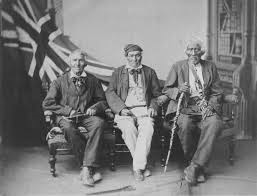
On returning from the War, he married Helen Martin. Helen had been born to Dutch parents, so was of Dutch ancestry, but she had been captured as a child and reared among the Mohawk. She was considered a woman of the tribe, of the Wolf Clan, who could transmit status to her children. Helen and John had several children, one of whom, George Henry Martin Johnson, would become a Sachem of the Wolf Clan in time. In the years following the deaths of Brant, Norton and others of their generation, the tribe was in need of good leadership. John Johnson served as an interpreter, diplomat and buffer between his people and the British. The Great Council recognized his service by installing him as a Pine Tree Chief. Johnson posed with other veterans of the War of 1812 who became leaders among their people in an 1882 photograph. He died in 1886, in his nineties, respected by his people. His granddaughter Pauline Johnson, became a respected Native American poet. Sakayengwaraton is seated on the left, by the draped British flag below.
Subscribe to:
Posts (Atom)