Gayusuta and Washington

Gayusuta and Washington
Showing posts with label Johnson family. Show all posts

Friday, August 4, 2017

Artist: Pauline Johnson of the Mohawk, 1861-1913

Education for women was becoming more accepted in the 19th century, but a woman who was a published poet and novelist was still rare.  Even rarer still were Native women who wrote for publication.  Pauline Johnson, 1861-1913 a mixed-race Mohawk woman of the Six Nations Reserve in Ontario, Canada, beat these odds.

A word on her ancestry, because there are a great many myths and misconceptions.  The Mohawk traditional home range was New York.  In the 18th century, Anglo-Irish Indian Agent Sir William Johnson was well-known to the Mohawk and lived with a Mohawk woman, Mary (Molly) Brant, the sister of Mohawk war chief Joseph Brant.  The Mohawk had, for the most part, accepted and adopted to English customs, converting to Anglicanism and farming.  As was often customary, when a Mohawk person was baptized, he or she often took the name of a prominent White person.  Thus, in 1758, when Pauline Johnson's great-grandfather was baptized, he took or was given the name Jacob Johnson.  Jacob is a Bible name and Johnson honored Sir William.  However, Jacob was not, as is commonly asserted, a biological son or nephew of Sir William.  Jacob would go on to marry a Mohawk woman.  Their son, John Smoke Johnson, was a veteran of the War of 1812 and later made a Pine Tree Chief.  He was not a hereditary sachem, but was chosen as a chief because of his abilities in war, as well as his ability to work with Whites.

John Smoke Johnson married a woman of the Wolf Clan who carried the authority to chose one of the hereditary sachems of the Mohawk Nation.  Their son, George, was thus a Wolf Clan Sachem.  Like his father, George had a flair for public speaking, diplomacy and languages.  He was a church translator and government interpreter.  He fell in love with Emily Howells, the sister-in-law of an Anglican missionary with whom he worked as a translator.  Emily's family opposed the match because George was Mohawk.  George's family opposed the match because Emily, being White, would carry no status within the tribe.  They felt that a sachem should marry a woman who could transmit her status and clan membership to her children.  George and Emily stuck to their guns and, in 1853, they were married.  By 1856, George built Chiefswood, a timber mansion house similar to what well-to-do White families would have lived in at the time.  The families eventually came around and accepted the marriage.

Emily Pauline Johnson was born at Chiefswood in 1861.  Her parents instilled in her respect for both the Anglo and Mohawk heritages.  Grandfather John Smoke was still alive and his stories fired young Pauline's imagination.  She would grow up understanding Mohawk but not speaking it well.  While other Native children were sent away to boarding schools, Emily insisted on teaching Pauline at home.  George had acquired a library and Pauline loved poetry, devouring Tennyson, Keats, Browning and Longfellow.  At the age of 14, Pauline went to Brantford Central Collegiate and graduated in 1877.  A well-to-do young woman of the time didn't work outside the home, so Pauline had plenty of opportunity to begin writing and acting in amateur theatricals.  She published her first work, "My Little Jean" in 1883.  Then, in 1884, her father died.  The family rented out Chiefswood and moved to a modest home in Brantford.  Pauline now had to make her acting and writing pay.

In 1885, she published "A Cry From an Indian Wife," basing it on an incident from the recent Riel Rebellion.  She would later travel to New York, and write a poem honoring Seneca leader Red Jacket.  Then, in 1886, she wrote a poem to commemorate the unveiling of the Joseph Brant Statue in Brantford.  By the 1890's, she was regularly publishing in periodicals in Canada.  She began giving readings of her poems, wearing Native dress to recite works dealing with Native history and legends, and also writing conventional poetry of the time.  This was an era of interest in all things Native, including the Wild West shows of the period, which were popular throughout North America and Europe.  Later in life, she moved to Vancouver, where some of her work dealt with the local Suquamish people.  She died in Vancouver of breast cancer in 1913.  She was cremated and her ashes buried near Siwash Rock in Stanley Park.  In 1922, a memorial cairn was erected at the site.

Tuesday, March 21, 2017

Whose Picture Is It: the Johnson/Brant Portrait by Benjamin West

Several members of Sir William Johnson's extended family followed him into what became the family business, serving as Superintendents in the British Indian Department.  One of these was Guy Johnson (c 1740-1788).  Years later, noted portraitist Benjamin West would paint a picture depicting a seated British officer in uniform, wearing a blanket or piece of cloth matchcoat style around his shoulders.  A Mohawk warrior can be seen behind him.  The warrior is delivering advice or intelligence of some kind, to which the officer is listening and pondering intently before making up his mind on what to do.

The cultural sensitivities of this portrait aside, debate exists over whether West meant to depict Sir William Johnson and Joseph Brant, or Guy Johnson and Joseph Brant.  The warrior is almost certainly Brant, who was a Mohawk war chief.  He was active in that capacity during the final years of William's life, and would work closely with two other Johnsons, Guy, and Sir John Johnson, 2nd Baronet.  Neither John nor Guy were sons of Native women.  John (1741-1830), was the son of William Johnson by his first long-term companion, a German woman by the name of Catherine Weisenberg.  Guy, who immigrated from County Meath, Ireland in 1756, would later marry William's daughter and John's sister Polly, another of Catherine's children.  In modern terms it would be highly inappropriate for any of these men to adopt aspects of Native dress but 18th century people had a fascination with Natives and wouldn't have thought anything of it.

Guy served as William's assistant for many years, himself amassing a fortune in what was once Mohawk land.  William died in 1774.  Despite not being the legitimate son of William Johnson, John inherited the lion's share of his father's estate and was later knighted and created a baronet, giving him an equal right to the title of Sir John Johnson.  Meanwhile, Guy succeeded his uncle as Superintendent of Indian Affairs for the British Indian Department, Northern colonies, working in tandem with John Stuart in the South.  During the American Revolution, the Johnsons' lands and homes were confiscated.  Not only were they Loyalists, which was bad enough in American eyes, but their close association with the Mohawk, particularly Brant, was unforgivable.  Both men would have made valuable prisoners and much time and intelligence was spent trying to capture either John or Guy while their empire was being dismembered in their absence.  Johnson Hall, where Molly Brant had presided over gatherings attended by local White and Native dignitaries including her brother Joseph, as well as Guy Park, in what is now Amsterdam, New York. 

The Johnson family fled to Canada, and quickly reestablished their roles in the Indian Department as well as acquiring extensive landholdings in Canada.  Like his father, John had a large family, though none of his children married Natives and several of his sons became British officers.  Guy's wife Polly, died during the flight from New York to Canada.  A large and powerful family such as this routinely makes enemies and the Johnsons had their share.  In 1782, as the Revolution would down, Guy was accused by several British officers of misappropriating funds in the Indian Department.  He left John in charge at Fort Niagara and went to London to clear his name, dying there in in 1788.  John succeeded his cousin/brother-in-law as Superintendent in 1782 and served in that capacity in Canada for many years, dying in 1830. 

So, whose portrait is it?  That remains a mystery. 


Wednesday, November 2, 2016

Great Leader: Sakayengwaraton of the Mohawk

The Iroquois' Great Law of Peace, or Constitution, specifically allowed for two types of leadership.  Sachems were based on hereditary descent through the matrilineal line.  However, men who distinguished themselves in battle or had other important skills or experience to offer could be appointed as Pine Trees, who had the authority to sit in council with the Sachems, advise them or work with them on important issues.  We've already met one Pine Tree Chief, John Norton.  John Smoke Johnson (1792-1886) was another veteran of the War of 1812 who likely would have worked with and known Norton quite well.

Though some sources erroneously indicate that John was related to Sir William Johnson, perhaps a grandson through Molly Brant or another Mohawk woman, he was not mixed race.  John was born in 1792 on the Grant River Reserve in Canada.  His father, Jacob Johnson, had been a godson of Sir William Johnson, who had sponsored him at his baptism into the Anglican faith.  As was common custom at the time, Jacob Johnson took or was given an English first name and his sponsor's last name.  Jacob Johnson married a woman of the Bear Clan, and passed the Johnson surname along to his children.  John grew up just in time to serve in the War of 1812 along with another John, John Brant, who was also being groomed for a leadership role within the tribe.  His service in the army as a Native auxiliary marked John Johnson as a warrior to watch.

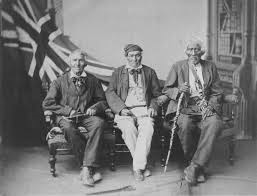
On returning from the War, he married Helen Martin.  Helen had been born to Dutch parents, so was of Dutch ancestry, but she had been captured as a child and reared among the Mohawk.  She was considered a woman of the tribe, of the Wolf Clan, who could transmit status to her children.  Helen and John had several children, one of whom, George Henry Martin Johnson, would become a Sachem of the Wolf Clan in time.  In the years following the deaths of Brant, Norton and others of their generation, the tribe was in need of good leadership.  John Johnson served as an interpreter, diplomat and buffer between his people and the British.   The Great Council recognized his service by installing him as a Pine Tree Chief.   Johnson posed with other veterans of the War of 1812 who became leaders among their people in an 1882 photograph.  He died in 1886, in his nineties, respected by his people.  His granddaughter Pauline Johnson, became a respected Native American poet.  Sakayengwaraton is seated on the left, by the draped British flag below.